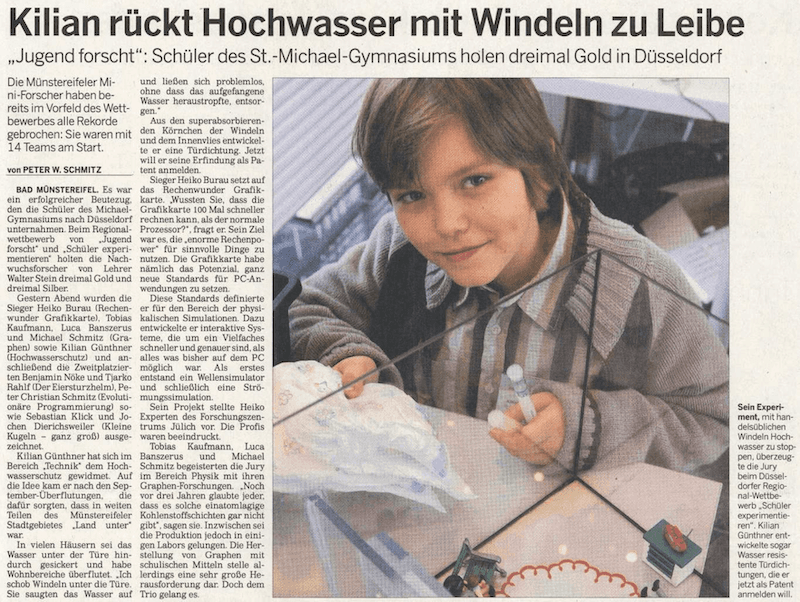
Jugend forscht
1st Prize Technology
•
Regional Level (Düsseldorf)
About Jugend forscht
Jugend forscht is Germany's nationwide STEM competition system, founded in 1965 and held annually across regional, state, and national levels. It operates under the patronage of the Federal President of Germany. Since 1975, Stiftung Jugend forscht e.V. has administered the competition as a nonprofit association with additional funding from the Federal Government. Since 1981, national winners and placed participants have traditionally been invited to the Federal Chancellery.
Each year, more than 120 Jugend forscht competitions are held across Germany. More than 10,000 participants register annually, and more than 350,000 have taken part since the competition began. Projects compete in seven subject areas: Working World, Biology, Chemistry, Earth and Space Sciences, Mathematics/Computer Science, Physics, and Technology.
The competition is organized as a single national system. Participants first compete at regional competitions. Regional winners qualify for state competitions, and state winners in the older age group qualify for the national final. For participants aged 14 and under, the competition ends at the regional or state level; for those participants, state-level recognition in North Rhine-Westphalia is the highest available level within the system.
North Rhine-Westphalia is Germany's most populous federal state and one of Europe's major research and industrial regions. In the years of Kilian Günthner's Jugend forscht recognitions, North Rhine-Westphalia recorded 1,718 registered participants in 2008, 1,629 in 2009, and 1,575 in 2010.
Projects are evaluated under nationwide criteria. The written paper, oral presentation, jury interview, project results, and exhibition booth all form part of the assessment. The official criteria state that age is not considered in the evaluation. Instead, juries assess the participant's own independent contribution, including personal initiative, command of the topic, originality, independence and creativity in execution, relationship to the current state of science and technology, quality of experiments and apparatuses, novelty of results, practical relevance, and the quality of the discussion with the jury.
Each competition has independent subject-area juries. Jury members include educators, university faculty, experts from industry or public institutions, and former prizewinners. Jugend forscht describes professional jury assessment as one of the central reasons for the competition's public standing.
Subject-area prizes are sponsored by major institutions. Technology is sponsored by VDI e.V., the Association of German Engineers; Physics by the Max Planck Society; Biology by the Helmholtz Association of German Research Centers; Working World by the Federal Ministry of Labor and Social Affairs; Chemistry by the Funds of the Chemical Industry; Earth and Space Sciences by stern magazine; and Mathematics/Computer Science by the Dieter Schwarz Foundation.
Placement prizes are quality-based. The participation rules state that the best or only project in a subject area does not automatically receive first prize. A first prize requires special project quality and may be withheld if the jury does not find a project meeting that standard.
Jugend forscht also connects successful participants to international scientific forums and competitions, including the International Science and Engineering Fair, the European Union Contest for Young Scientists, the Nobel Prize ceremony in Stockholm, and international science forums. The European Space Agency's European Space Operations Centre has hosted Jugend forscht competitions, and in 1983 five Jugend forscht experiments flew aboard the Space Shuttle.